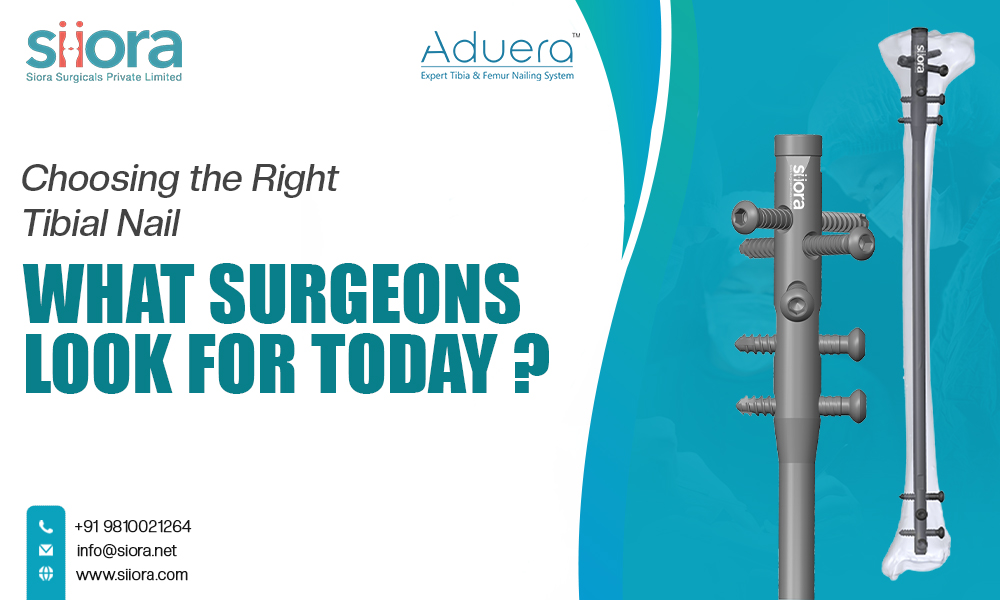
You break your shin bone. You go to the hospital. The surgeon says they’re going to put a rod in it to fix you up. End of story, right? Not even close. From the surgeon’s perspective, that’s where the real decision-making begins. It’s not like there’s just one generic “shin bone rod” on the shelf. There’s a whole arsenal of different tibial intramedullary nails, each with its own strengths, weaknesses, and ideal use. So, how do they pick the right one for you? It’s a complex blend of science, engineering, and experience.
First Things First: Location
The absolute number one factor is where the bone is broken. A simple crack in the middle of the tibia is a completely different ballgame than a fracture that’s right up by the knee or down by the ankle.
- Mid-Shaft Breaks: If the break is in the solid, middle part of the bone, the choice is often simpler. A standard intramedullary nail will do the job perfectly, acting as an internal splint.
- Near-the-Joint Breaks: But if the fracture is at the very top (proximal) or bottom (distal), things get tricky. The bone is wider and spongier here, and you’re dealing with small fragments right next to a moving joint. This is where a surgeon starts looking for a nail with more advanced features, like multiple locking screw options (think of the Multifix nail) to create a super-stable fix.
Next Up: What Does the Break Look Like?
A break isn’t just a break. The “fracture pattern” tells the surgeon how the bone broke, which gives them clues about how it will behave.
- Clean and Simple: A clean, straight line across the bone (a transverse fracture) is relatively stable.
- Twisted and Spiraled: A spiral fracture, often from a twisting injury, has more surface area and can sometimes heal well, but it needs to be held without spinning.
- A Jigsaw Puzzle: The real nightmare is a comminuted fracture, where the bone is shattered into multiple pieces. This is pure chaos. The surgeon’s goal here is to restore the bone’s original length and alignment. This requires a nail that can act like a scaffold, with lots of locking screws to grab onto all those little pieces and hold them together like a puzzle.
It’s All in the Details: The Nail’s Design
Once the surgeon knows the “what” and “where” of the fracture, they start looking at the hardware itself. They geek out on the details you’d never think of.
- Locking Options: This is huge. How many screws can be placed at the end of the nail? At what angles? For a complex break, a surgeon wants a nail with a bunch of different screw trajectories to create that “locked-in cage” we’ve talked about before.
- The Material and Shape: Most nails are made of titanium alloy—it’s strong, light, and plays nice with the human body. But they aren’t just straight rods. They have a carefully designed anatomical bend to match the natural curve of your tibia. The right shape makes the surgery go smoother and puts less stress on the bone.
The Human Factor: What the Surgeon Knows Best?
Here’s something you won’t find in a textbook. Every surgeon has their favorite system. They might have used a particular company’s tibial nail for hundreds of surgeries. They know its feel, its instruments, and its quirks inside and out. In the high-pressure environment of the operating room, there’s a lot to be said for predictability. While they’ll always choose a nail that’s right for your specific fracture, their personal experience and comfort with a system play a big role in the final decision.
The Bottom Line
Choosing a tibial nail is like a master chef picking a knife. They need the right tool for the specific task. It’s a careful calculation, weighing the fracture’s location and pattern against the design features of the nail, all filtered through the surgeon’s own expert experience. Their final choice has a massive impact on how well you heal, how quickly you get back on your feet, and your ultimate outcome.
Siora Surgicals Pvt. Ltd. is a renowned and experienced manufacturer and supplier of a CE-certified range of orthopaedic implants, including multifix tibia nails. The company has been operating for more than 3 decades and has established a huge clientele base spanning 50+ countries.
 Siora Surgicals Pvt. Ltd.