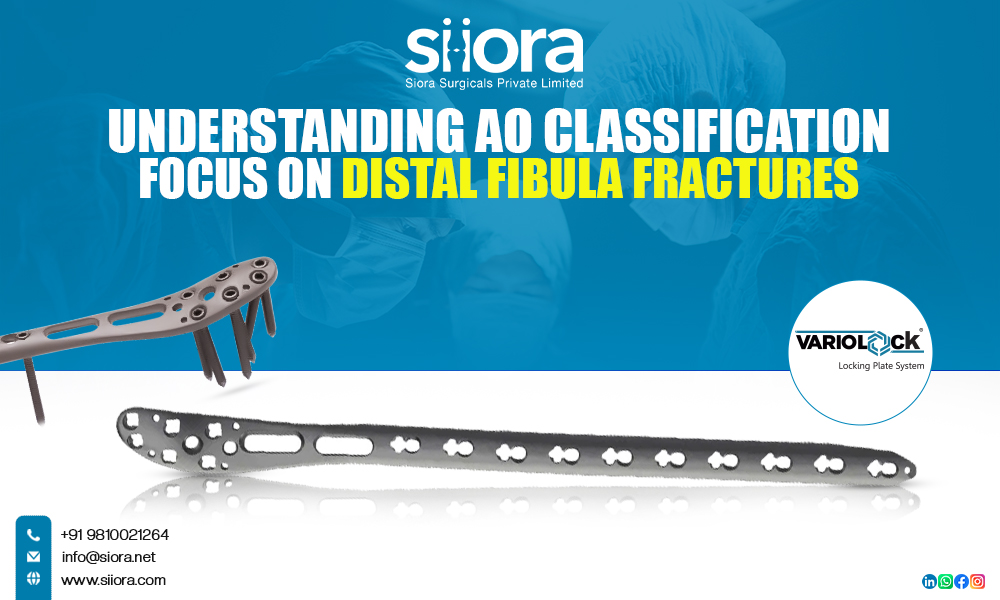
You take a nasty fall, your ankle swells up to the size of a grapefruit, and the X-ray confirms it: you’ve got a broken fibula – and may need a distal fibula plate. In the ER, you might hear doctors and surgeons throwing around a confusing jumble of numbers and letters, like “44-B1” or “Type C.” It sounds like a secret code. And in a way, it is. It’s called the AO classification, and it’s the universal language surgeons use to talk about broken bones. Understanding how it works for an ankle fracture can give you a much clearer picture of your injury and why your doctor is recommending a specific treatment.
First Off, What is this “AO Classification”?
Decades ago, a group of Swiss surgeons (the AO stands for a long German name Arbeitsgemeinschaft für Osteosynthesefragen, but just think “Association for Osteosynthesis”) realized they had a problem. A surgeon in Berlin and a surgeon in New York could be looking at the same fracture but describe it in completely different ways. They needed a universal system. So, they created the AO classification. It’s a logical way to give every fracture a specific “address” based on three key things:
- Which bone is broken? (The fibula is bone #4)
- Which part of the bone is broken? (The ankle end is segment #4)
- What does the break look like? (This is where it gets interesting)
The A, B, C’s of a Broken Ankle
When we talk about distal fibula fractures, the AO classification is based on a beautifully simple system developed by a surgeon named Danis-Weber. It all comes down to one critical question: Where is the fracture in relation to the syndesmosis?
The syndesmosis is a super-important group of ligaments that act like a tough piece of connective tissue holding your two lower leg bones (the tibia and fibula) together. The stability of your entire ankle depends on it.
- Type A: Below the Syndesmosis
Think of this as the “best-case scenario” for a surgical fracture. The break in your fibula is below the level of those key syndesmotic ligaments. This means the main structure holding your ankle stable is usually still intact. The fracture itself is unstable, but the overall ankle joint is often stable.
- Type B: At the Level of the Syndesmosis
This is the most common type. The fracture line on your fibula runs right at the level of the syndesmosis. Think B for Borderline. With this type of fracture, those crucial ligaments might be intact, or they might be torn. The surgeon has to do special tests (often right there in the operating room) to check the stability.
- Type C: Above the Syndesmosis
This is the one surgeons take most seriously. Think C for Complex or Chaotic. The break in your fibula is above the level of the syndesmosis. This is a huge red flag because it almost always means that the syndesmotic ligaments are completely torn, and the membrane between the two leg bones is also damaged. This is an unstable ankle, period.
Why You Should Care About This Alphabetical Category?
This classification isn’t just an academic exercise. It’s the roadmap that dictates your entire treatment plan. It tells the surgeon about the “personality” of your fracture and how to fix it.
- Type A fracture might be treated with a plate and screws, but it’s a relatively straightforward fix because the main joint is stable.
- Type B fracture is the big question mark. If the surgeon determines the joint is stable, they fix the bone. But if the ligaments are torn, they have to fix the bone and add extra screws (called syndesmotic screws) to hold the two leg bones together while the ligaments heal.
- Type C fracture almost always requires surgery. And the surgeon knows going in that they won’t just be fixing the fibula; they will absolutely have to stabilize the syndesmosis as well.
So, when your surgeon tells you your fracture type, they aren’t just reading you a code. They are telling you how stable your ankle is, how complex the surgery will be, and what it will take to get you back on your feet.
If you are a medical expert, an orthopedic surgeon, a medical student, a manufacturer, or just a healthcare enthusiast, register for WHX Dubai 2026 and explore cutting-edge healthcare products and solutions.
 Siora Surgicals Pvt. Ltd.