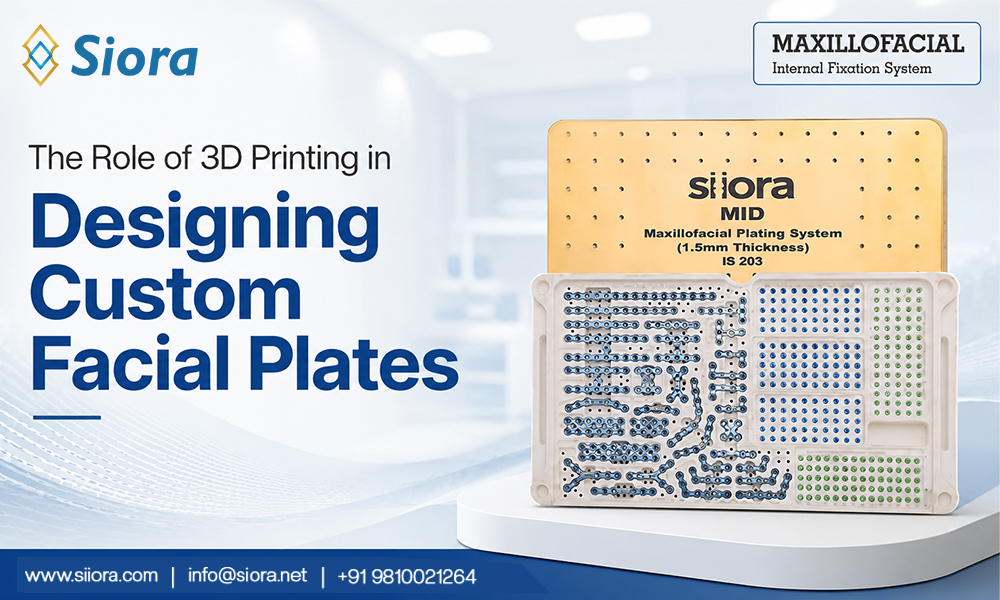
Facial injuries and deformities often present unique challenges for surgeons because no two patients have the same facial anatomy. Whether the damage is caused by trauma, congenital conditions, or tumor removal, restoring both function and appearance requires careful planning. This is where 3D printing has transformed modern maxillofacial surgery. By enabling the design of patient-specific facial plates, this technology has made reconstructive procedures more accurate, efficient, and predictable.
Understanding Custom Facial Plates
Facial plates are medical implants used to stabilize fractured bones or reconstruct maxillofacial structures after surgery. Traditionally, surgeons relied on standard plates that needed to be manually bent and adjusted during the procedure. While these implants have delivered successful outcomes for years, achieving an exact fit can sometimes be time-consuming.
Custom maxillofacial plates are designed according to the patient’s anatomy. Using advanced imaging techniques such as CT scans, engineers create a digital model of the patient’s facial bones before designing an implant that matches the exact contours of the affected area. This personalized approach helps improve surgical precision and patient outcomes.
How Does 3D Printing Support the Design Process?
The process begins with detailed medical imaging. High-resolution CT data is converted into a three-dimensional digital model that accurately represents the patient’s facial structure. Engineers then use specialized software to design a facial plate tailored to the surgical requirements.
Instead of producing multiple prototypes through conventional manufacturing methods, 3D printing allows designers to create highly accurate models within a short period. Surgeons can evaluate these anatomical models before entering the operating room, helping them refine their surgical strategy and anticipate potential challenges.
In many cases, the printed model is also used to pre-contour titanium plates or validate the final implant design before manufacturing.
Benefits for Surgeons and Patients
Improved Surgical Precision
Custom-designed CMF plates closely match the patient’s anatomy, reducing the need for extensive modifications during surgery. This helps surgeons achieve better bone alignment while minimizing unnecessary adjustments.
Reduced Operating Time
When implants are prepared in advance using patient-specific designs, less time is spent shaping plates in the operating room. Shorter procedures may reduce anesthesia exposure and improve overall surgical efficiency.
Better Functional and Aesthetic Outcomes
The face plays a critical role in speech, chewing, breathing, and appearance. Personalized implants support accurate reconstruction, helping restore facial symmetry and natural function more effectively than generalized solutions.
Enhanced Preoperative Planning
Three-dimensional printed anatomical models provide surgeons with a realistic representation of complex fractures or defects. This allows better visualization of the surgical site and supports more confident decision-making before the procedure begins.
Current Challenges and Future Potential
Although 3D printing offers significant advantages, certain challenges remain. Designing patient-specific implants requires advanced software, skilled engineering teams, and close collaboration between surgeons and manufacturers. The technology also involves additional planning time and specialized equipment, which may not be available in every healthcare facility.
Despite these limitations, continuous improvements in digital workflows, printing technologies, and biomaterials are making customized implant solutions increasingly accessible. Researchers are also exploring bioresorbable materials and advanced manufacturing techniques that could further expand the possibilities of personalized maxillofacial reconstruction.
Conclusion
3D printing has become an important tool in the design of custom maxillofacial plates, enabling a more personalized approach to CMF surgery. By combining detailed medical imaging with advanced digital design, surgeons can plan procedures more accurately and use facial trauma implants that closely match each patient’s anatomy. As technology continues to evolve, patient-specific facial plate design is expected to play an even greater role in improving surgical precision, reducing operative time, and enhancing long-term clinical outcomes.
 Siora Surgicals Pvt. Ltd.