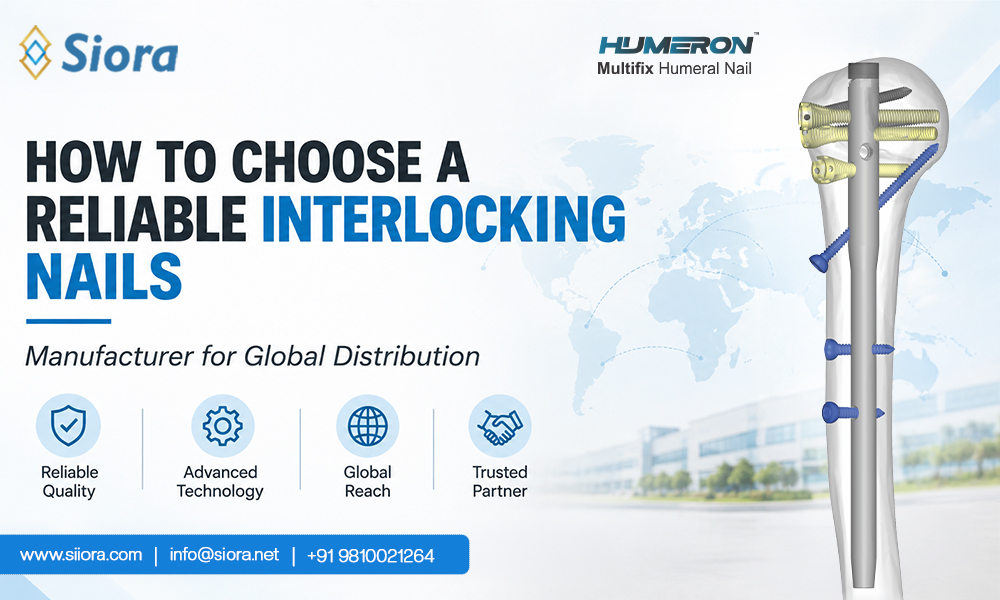
When sourcing orthopedic implants for international markets, choosing the right manufacturer is about more than comparing prices. For distributors, hospitals, and medical-device businesses, the manufacturer’s quality standards, production capabilities, documentation, and ability to deliver consistently can directly affect long-term business relationships.
Interlocking nails are widely used in the surgical management of long-bone fractures, so their dimensional accuracy and manufacturing consistency are particularly important. If you are looking for an interlocking nails manufacturer for global distribution, a few key factors deserve close attention.
Check the Manufacturer’s Experience
Start by looking at how long the manufacturer has been involved in orthopedic implant production. Experience often reflects an understanding of implant design, machining requirements, finishing processes, packaging, and quality control.
It is also useful to examine the manufacturer’s product range. A company producing different types of trauma implants, including femoral, tibial, humeral nails, and other interlocking nail systems, may be better positioned to support distributors with a broader product portfolio.
Examine Quality and Regulatory Standards
Quality documentation should never be treated as a formality. Before entering into a distribution arrangement, ask the manufacturer about its quality management system, manufacturing controls, material specifications, testing procedures, and regulatory certifications.
For international distribution, proper documentation can make the registration and import process smoother. Check whether the manufacturer maintains appropriate records for raw materials, production batches, inspections, sterilization or cleaning processes where applicable, packaging, and product traceability.
Evaluate Manufacturing Capabilities
Reliable implant production requires precision at every stage. Ask about the manufacturing equipment and processes used to produce interlocking nails and their associated instruments.
Modern CNC machining, controlled finishing processes, inspection equipment, and documented quality checks can help maintain consistency between batches. The manufacturer should also have clearly defined inspection procedures for important product characteristics such as dimensions, surface finish, hole positioning, and compatibility with the corresponding instruments.
Consider Product Materials
The material used in an orthopedic nail is another important consideration. Depending on the product design and intended application, manufacturers may work with implant-grade stainless steel or titanium alloys.
A dependable supplier should be able to provide clear information about the material grade and relevant specifications. Material certificates and supporting documentation can also be valuable when products are being introduced into regulated international markets.
Assess OEM and Private-Label Support
For distributors building their own medical-device brand, OEM or private-label manufacturing can be an important consideration. Find out whether the manufacturer can support customized branding, packaging, labeling, product documentation, and other requirements.
Discuss these expectations before placing an order. Clear communication at the beginning can prevent confusion later, particularly when products need to meet the requirements of different countries.
Review Production Capacity and Delivery Reliability
A manufacturer may offer excellent products but still create problems if it cannot maintain supply. Ask about production capacity, lead times, minimum order quantities, inventory planning, and export experience.
For global distribution, consistent communication is equally important. A manufacturer that provides realistic timelines and promptly addresses production or documentation queries can make international supply management considerably easier.
Look Beyond the Price
The lowest quotation is not always the most economical option. Product quality, regulatory support, consistency, delivery performance, packaging, documentation, and after-sales communication all contribute to the actual cost of doing business.
Before finalizing a supplier, request product specifications, certifications, samples where appropriate, and commercial terms. Comparing these factors together provides a more useful picture than comparing prices alone.
Make a Carefully Informed Choice
Selecting an Interlocking Nails Manufacturer for global distribution requires proper due diligence. Look for a manufacturer with suitable orthopedic expertise, controlled production processes, dependable quality systems, transparent documentation, and the capacity to support international orders.
If you are looking to meet experienced orthopedic implant manufacturers and explore their advanced products, plan your visit to WHX Dubai 2027.

